Daga
If you have notes on accuracy, content, site links, or any other requests regarding this page, please get ahold of us at contact@hamiltonandsonsauctions.com.
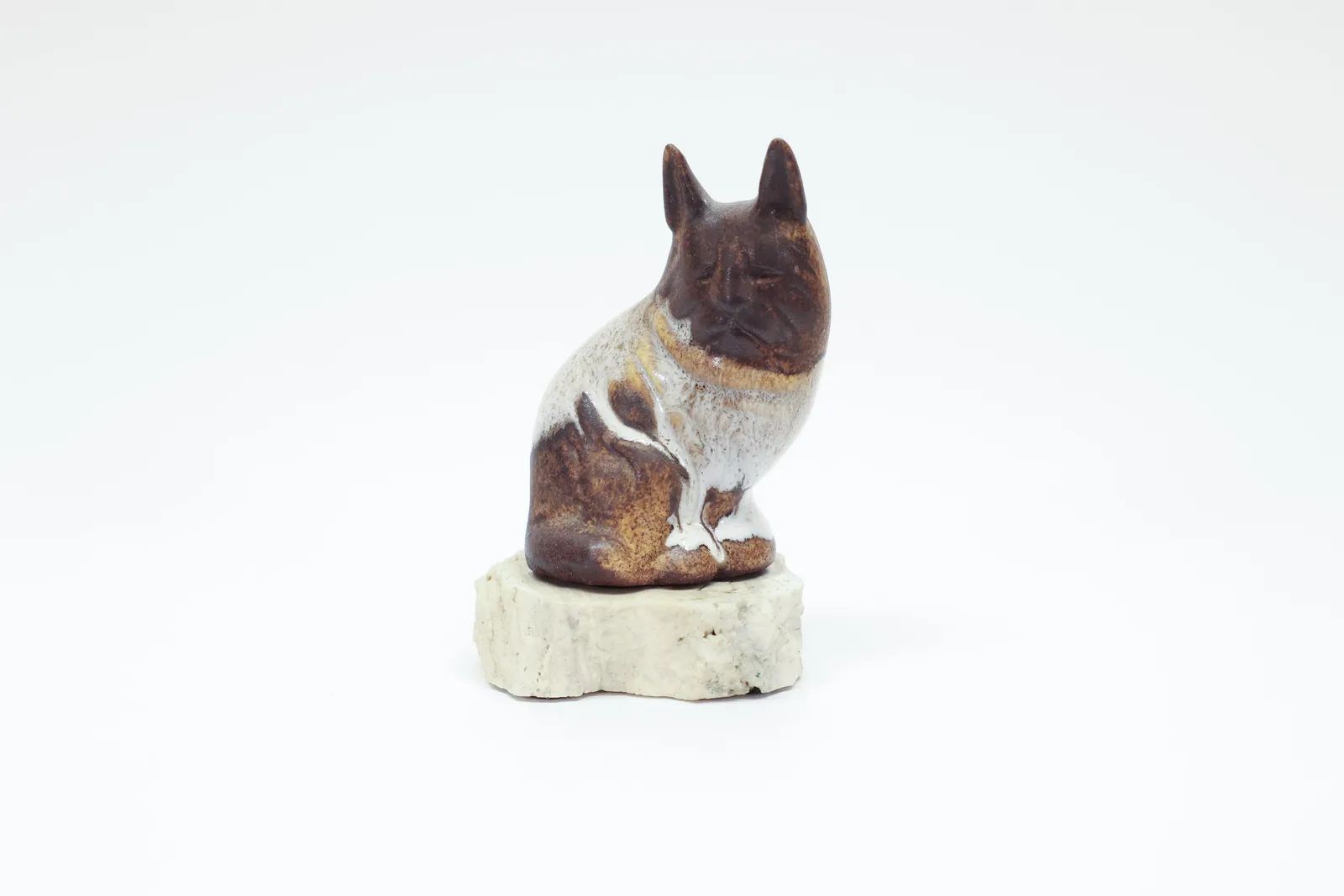
Maigonis Daga was a Latvian-born ceramic artist whose work spans two continents and a distinctive career arc. Born in Latvia in 1923, he immigrated to Australia in 1948 after war broke out in his home country. Once in Australia, he attended the famous Adelaide School of Art where he learned sculpture and studio ceramics, and after graduating he began his independent pottery firm in 1954.
His early Daga pottery is very modernist and looks strikingly dissimilar to most of his later pieces; he worked mainly in functional forms, but would slip-cast singularly decorative pieces as well, keeping his glazing and finishing simple during his Australian phase, most often earth-toned and monochromatic or dichromatic. His studio gained admirable success, but he closed it down to move to the U.S., where his output shifted markedly. This later, American art pottery centers around small animal forms on decorative plinths, showing off his sculpting ability, typically set on solid granite plinths with the ceramic sculptures on top taking natural forms, some abstract and some representational.
Collectors prize Daga pieces for this rare combination of Scandinavian-inflected modernist training and whimsical, naturalistic animal subjects, produced in relatively limited quantities by a single hand rather than a factory studio. Almost all of his works are marked with an incised "Daga," and some feature an engraved form number, which is especially common on his earlier pieces. Maigonis Daga passed away in 2001, after which the "Daga Design Studio" ceased production for several years, making his signed original works, especially the charming granite-mounted animal figures from his American period, particularly sought after by collectors of studio pottery and animalier ceramics.
Sources: