Maxfield Parrish
If you have notes on accuracy, content, site links, or any other requests regarding this page, please get ahold of us at contact@hamiltonandsonsauctions.com.
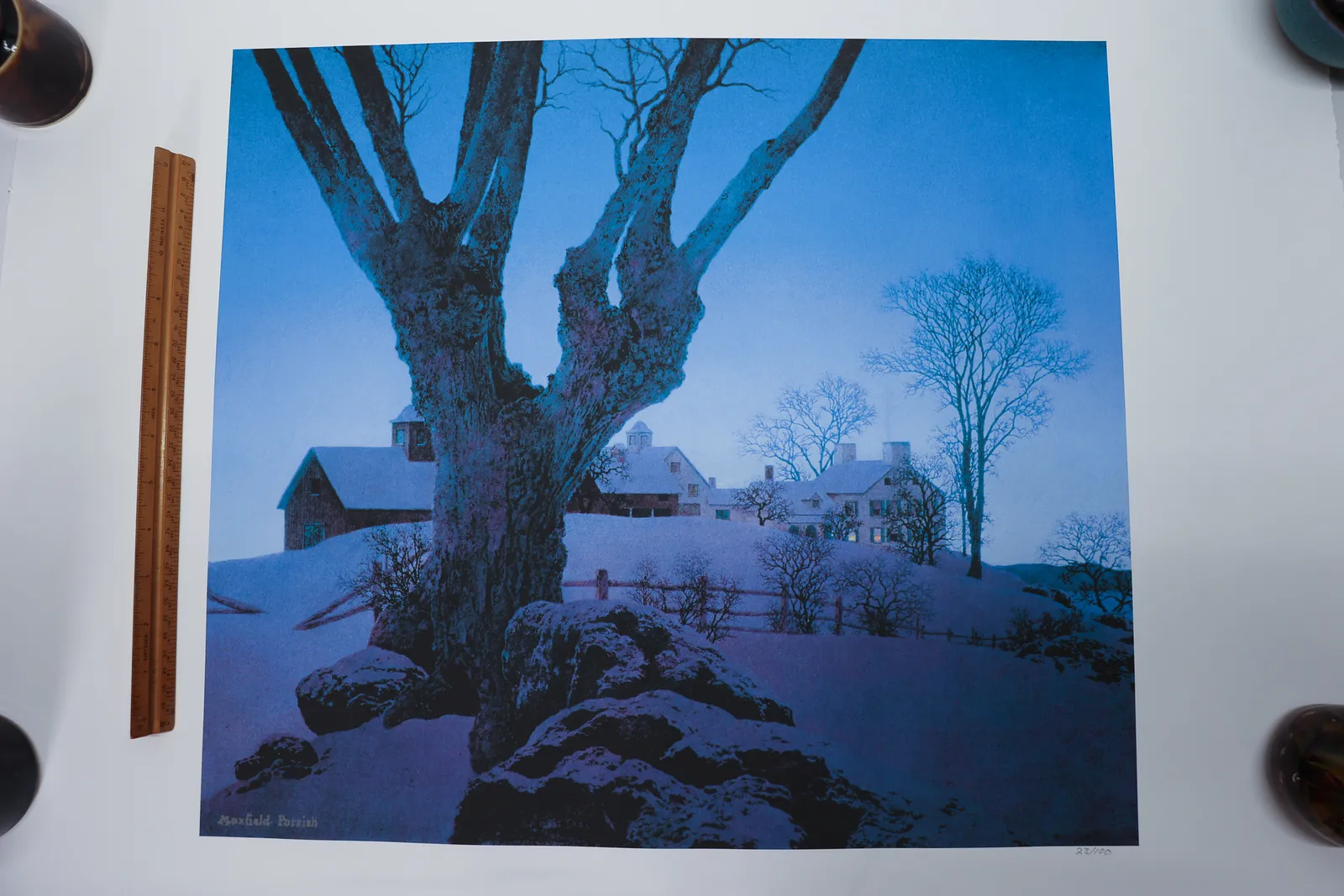
Maxfield Parrish (1870–1966) was an American painter and illustrator whose work defined much of the visual imagination of early twentieth-century America. Born the son of an artist, he was educated at Haverford College and studied art at the Pennsylvania Academy of the Fine Arts and the Drexel Institute of Art, both in Philadelphia. He was active as a painter and illustrator in the first half of the 20th century, and his works featured distinctive saturated hues and idealized neo-classical imagery.
Parrish became enormously successful producing magazine covers, posters, book illustrations, and advertising art, and over the course of two decades he created many posters, magazine covers, and book and advertising illustrations, and painted murals; by the 1920s he was the highest-paid commercial artist in the United States. He also created advertising for companies like Wanamaker's, Edison-Mazda Lamps, Colgate and Oneida Cutlery. His paintings are instantly recognizable for their glowing, jewel-toned skies and dreamlike landscapes, achieved through a meticulous glazing technique; a shade of cobalt blue has even been named "Parrish blue" after him. The National Museum of American Illustration deemed his painting Daybreak (1922) to be the most successful art print of the 20th century, underscoring the vast popular reach of his imagery through prints and reproductions.
Later in his career Parrish largely abandoned figural illustration in favor of pure landscape painting, particularly winter scenes of the New England countryside near his New Hampshire home. His popularity declined somewhat in the late 1930s, but his illustrations never lost favor with segments of the American public, and there was a renewed appreciation of his work in the 1960s and 1970s. This enduring appeal, combined with the technical brilliance and luminous color of his compositions, continues to make original Parrish works and vintage prints highly sought after by collectors of American illustration and Golden Age art.
Sources: