Navarro
If you have notes on accuracy, content, site links, or any other requests regarding this page, please get ahold of us at contact@hamiltonandsonsauctions.com.
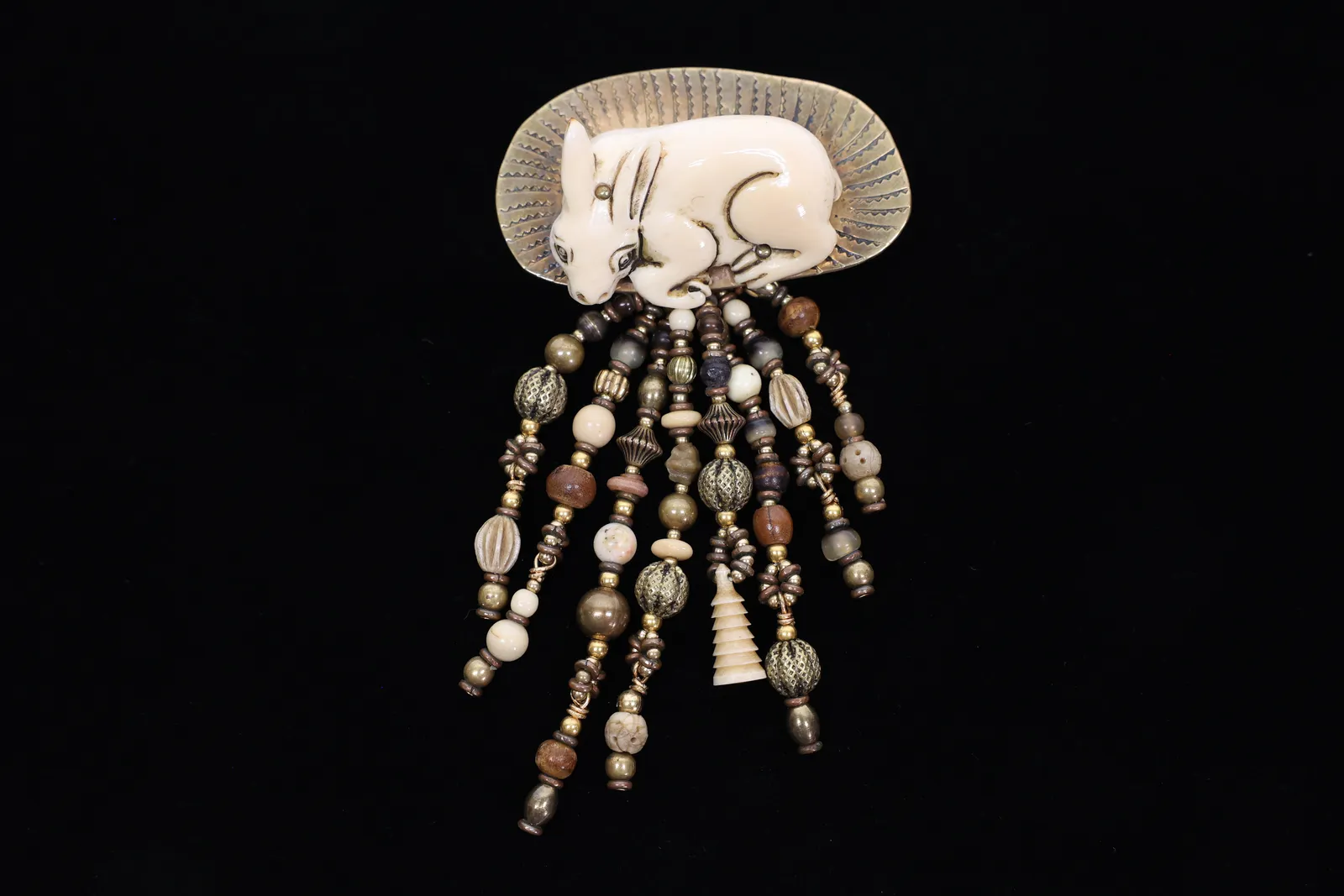
I now have solid information on David Navarro (David Navarro Potter), the San Francisco jewelry designer known for signed fringed brooches like this piece.
David Navarro, full name David Bernard Navarro Potter, was an American jewelry designer active from the 1970s through the 1990s and based in San Francisco. Born in Palm Beach, Florida in 1928 into a founding family of that city, he left a conservative upbringing behind and moved first to New York, where he immersed himself in a bohemian creative scene, studying acting and modern dance and running a curiosities shop, before relocating to San Francisco with his wife and business partner, Beverly Miller. Together they founded the jewelry house Navarro Alternatives, with David designing one of a kind, never seen before jewelry, while Beverly ran the business, and together they became the unexpected darlings of Saks Fifth Avenue, Neiman Marcus, I. Magnin, Barney's New York, Henri Bendel and many fine specialty stores.
Navarro's work was known for bold, sculptural assemblage jewelry that combined sterling silver and brass with found objects, natural materials such as bone, horn, and shell, and strands of semi-precious stone and glass beads, often arranged in dramatic dangling fringes. He was a San Francisco-based designer known for his innovative and unique jewelry, often incorporating repurposed materials and signature designs like the circle and point closure. That closure, created for his "Swept Away" collection, is now more widely recognized as the toggle clasp, a design detail that has become a lasting contribution to jewelry construction generally.
Pieces signed "Navarro" or "David Navarro" are sought after today as examples of 1970s–80s American studio and wearable-art jewelry. Navarro was also a sculptor and artist, and his work is considered highly collectible. Because each design was conceived as a one-of-a-kind or small-batch studio piece rather than mass-produced, and because Navarro trained a small circle of studio artisans who helped realize his designs during the label's peak years, well-preserved signed examples, especially elaborate figural or beaded brooches like this one, remain desirable to collectors of vintage California art jewelry.
Sources: